Technology | Concept & R&D stage
Material science engineered for robotic construction.
CircularBuild is developing printable hemp-mineral composites designed to combine lower-carbon binders, renewable bio-aggregates and large-scale additive manufacturing.
The product is not a single material. It is a validated material-process system.
Illustrative cross-section — geometry not to scale
01 — The material system
Six variables that cannot be designed separately.
A printable composite is not a recipe with a process bolted on. Feedstock, binder chemistry, additives, water content, extrusion parameters and curing behave as one coupled system — change any one and the others have to be re-solved.
Our development work is therefore organised around the interactions, not the ingredients. That system knowledge is the intended core of the technology.
Move one variable and the others move with it
01Hemp shiv
Bio-based lightweight aggregate selected for geometry, particle size, moisture content and consistency.
02Mineral binder
A lower-clinker binder system potentially incorporating lime, hydraulic components, fly ash and other supplementary cementitious materials.
03Additive package
Rheology modifiers and setting-control additives tailored to the printing process.
04Water control
Moisture content calibrated for pumpability, extrusion and shape retention.
05Printer parameters
Nozzle dimensions, flow rate, travel speed, layer height and pause time.
06Curing protocol
Environmental conditions and curing sequence designed around stability and final performance.
02 — Hemp as engineered feedstock
Hemp shiv is a specification problem before it is a sustainability story.
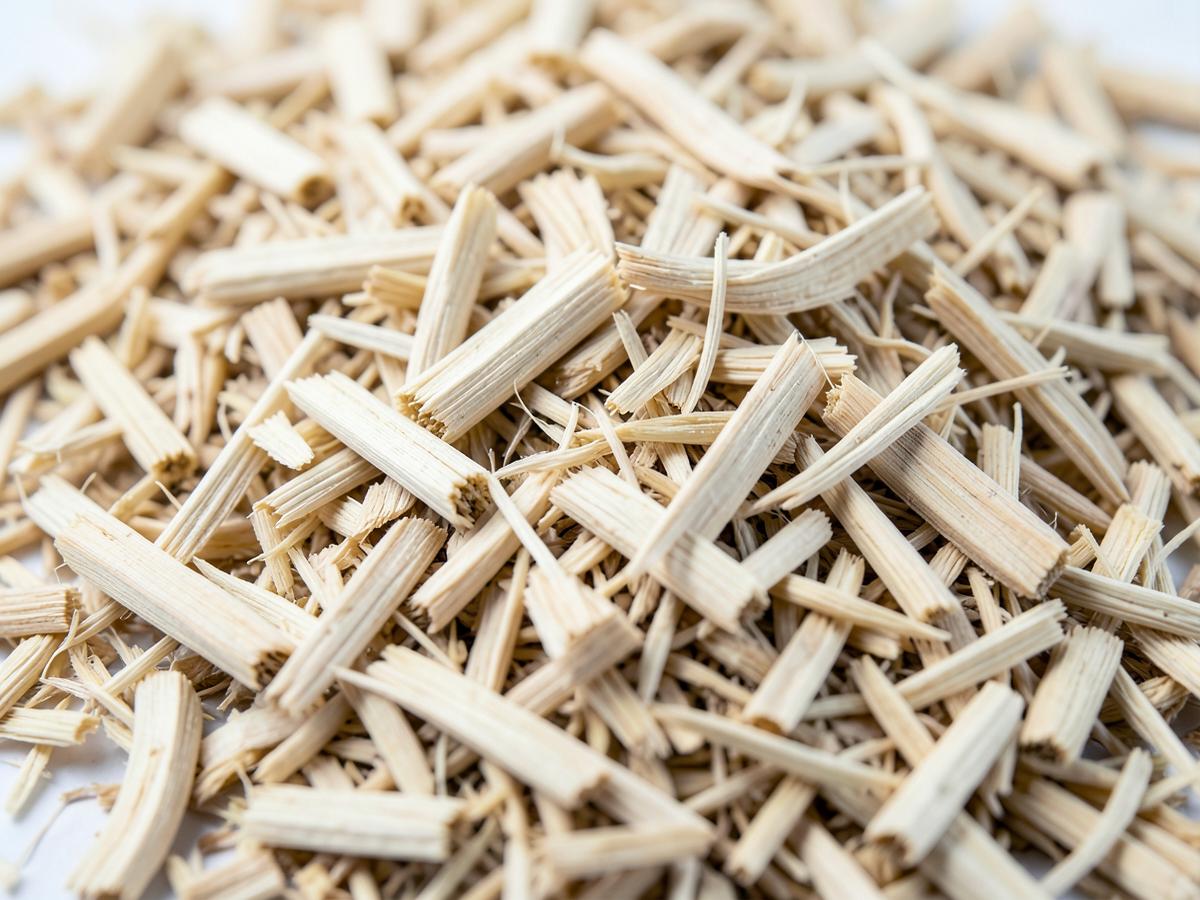
Hemp shiv is the chopped woody core of the industrial hemp stalk — porous, low density, renewable, and carrying biogenic carbon fixed during plant growth. In a mineral composite it acts as a lightweight bio-aggregate rather than a structural fibre.
For printing, the interesting properties and the difficult ones are the same properties. Porosity gives insulation and moisture buffering; it also drives water demand, binder coating behaviour and nozzle reliability.
Particle size and grading
Controls flow through the nozzle and the achievable layer height.
Moisture content
Shifts the water balance of the mix batch to batch.
Dust and fines
Increase water demand and can change setting behaviour.
Batch consistency
Agricultural feedstock varies by harvest, region and processor.
Particle grading — conceptual
- Finesincreases water demand
- Target fractionspecified band
- Coarserisk of nozzle blockage
- Oversize / fibrescreened out
Bands are indicative. A controlled specification is still to be defined.
03 — Binder chemistry
Lower-carbon chemistry pulls against printability. Both have to hold.
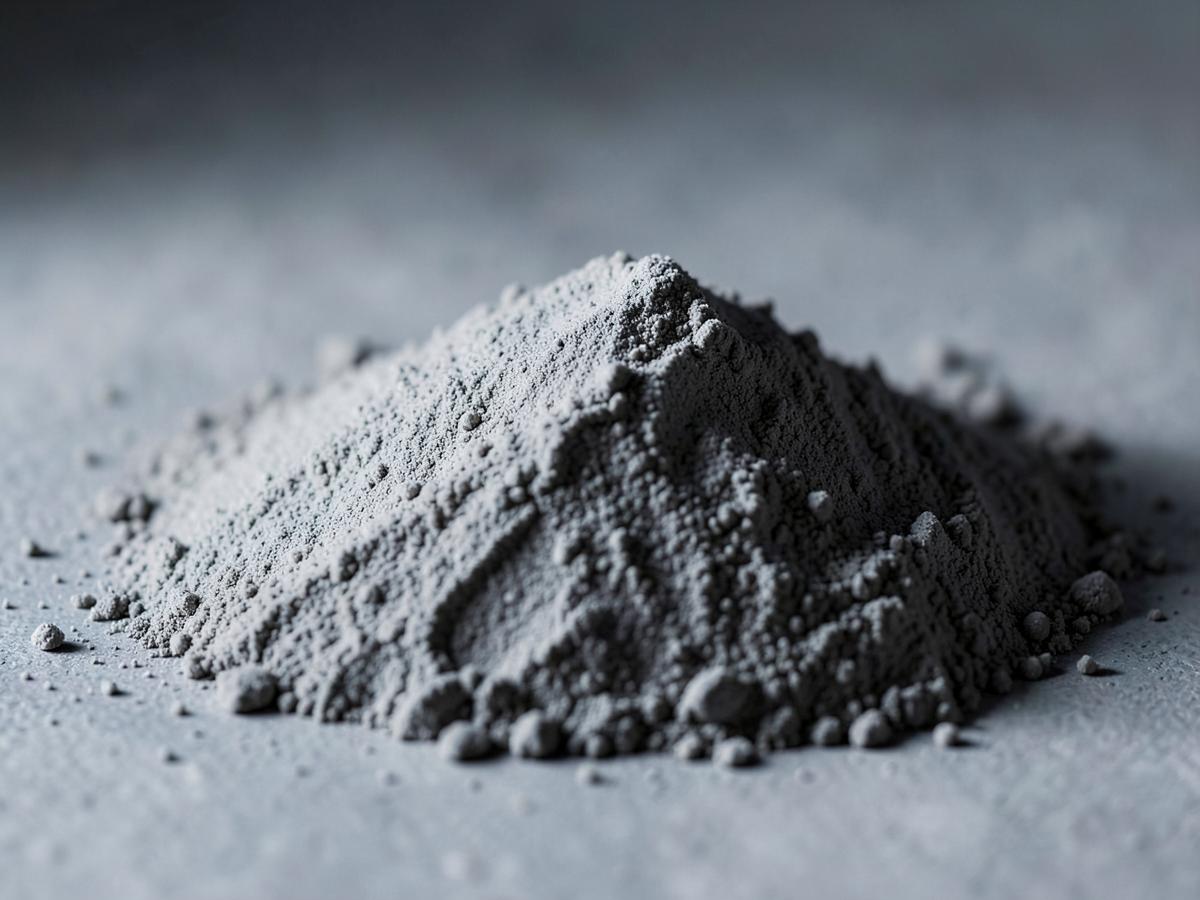
Reducing clinker content lowers embodied carbon and typically slows early strength development. Printing needs the opposite: material that stabilises fast enough to carry the layers above it, minutes after deposition.
Our binder work sits in that conflict — blending hydraulic components, lime chemistry and supplementary cementitious materials to find a window that satisfies carbon targets and process demands at the same time.
Formulation trade-off
Pulls toward lower carbon
- Embodied carbon
- Clinker reduction
- SCM content
Pulls toward print performance
- Early stability
- Printability
- Buildability
04 — Fly ash and industrial by-products
A material stream we intend to qualify, not assume.
Fly ash and comparable supplementary cementitious materials can reduce clinker demand and divert industrial by-products from landfill. They are also variable, regionally inconsistent, and increasingly contested as coal generation declines.
We treat every by-product stream as a candidate that must pass a qualification chain before it enters a formulation — and we design binder systems that are not dependent on a single source.
By-product qualification chain
- 01Source identification
- 02Chemical and mineralogical characterisation
- 03Contaminant and leaching screening
- 04Reactivity assessment
- 05Formulation trial
- 06Rheology and print behaviour
- 07Durability and performance testing
- 08Supply-consistency review
05 — Rheology
The material has to behave like three different materials in ninety seconds.
It must flow under pressure, leave the nozzle as a continuous bead, then stop behaving like a fluid and hold its own geometry while the next layers arrive. Rheology is where the material and the machine actually meet.
01 — Pump
The material must flow.
02 — Extrude
The material must leave the nozzle continuously.
03 — Build
The material must stop flowing and retain geometry.
Conceptual behaviour. No measured values are shown.
06 — Printability
Printability is a set of simultaneous constraints, not a single property.
A mix can pump beautifully and collapse under the fourth layer. It can hold geometry perfectly and bond poorly between layers. Every criterion below has to be satisfied at once, with the same formulation, on the same equipment.
Pumpability
Moves through mixing and delivery without blockage.
Extrusion quality
Continuous, dimensionally consistent bead.
Buildability
Carries the layers deposited above it.
Interlayer bonding
Strong interface between successive passes.
Open time
Stays printable across real construction pauses.
Geometric accuracy
Holds the designed section under its own weight.
Illustrative requirement map — no performance values
07 — Printed wall architecture
Printing lets geometry do work that material used to do alone.
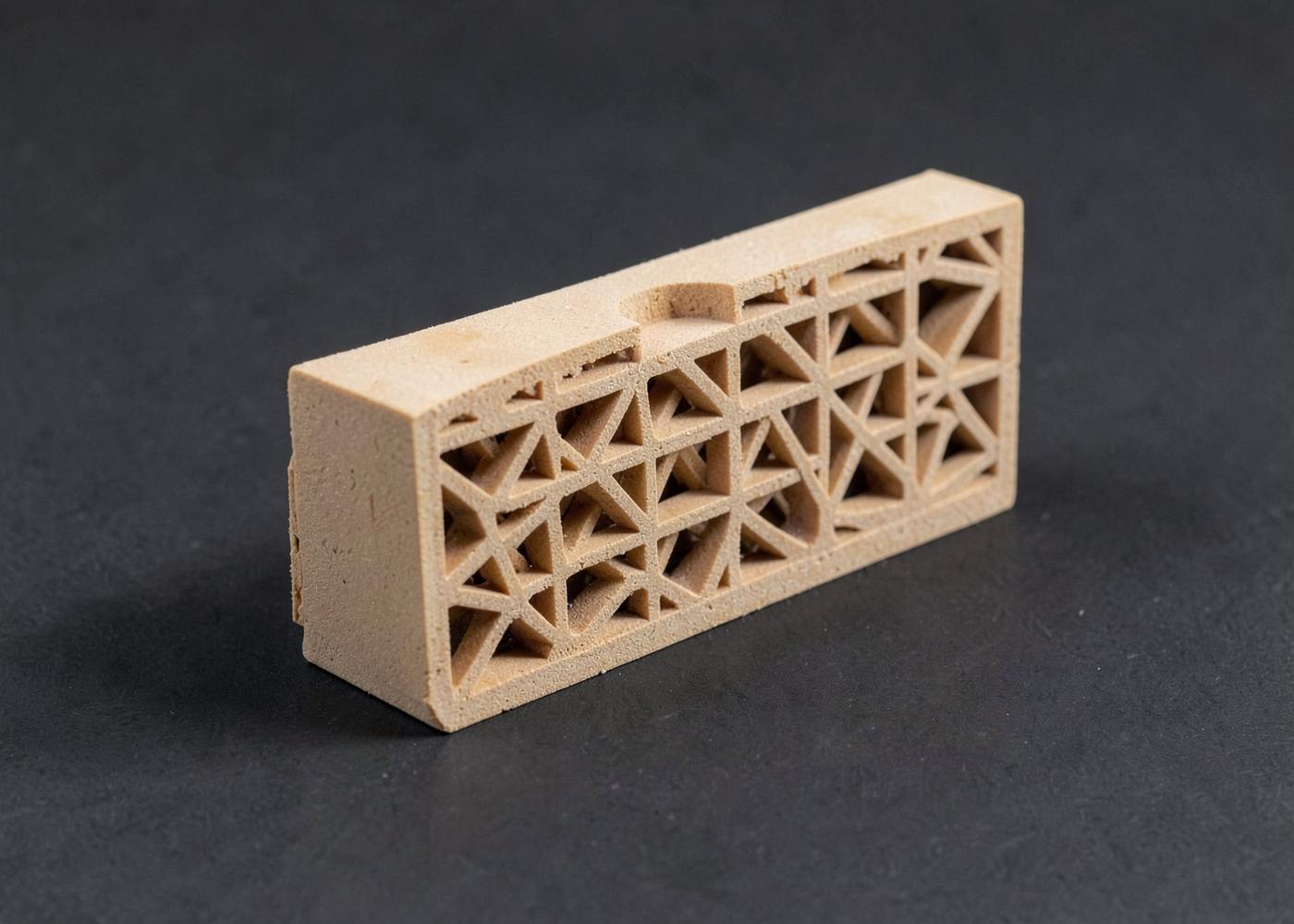
Additive construction removes the formwork constraint. Wall sections can vary in thickness, carry internal cavities, place mass where it is useful and leave voids where it is not — at no additional tooling cost.
That is where a lightweight bio-composite becomes strategically interesting: geometry can compensate for what the material does not do on its own.
01
Solid reference wall
Simple baseline geometry, printed as a continuous section.
02
Cellular wall
Internal lattice placing material only where it is needed.
03
Integrated wall
Thermal zones, service channels and structural interfaces in one print.
08 — Structural strategy
Envelope first. Structure is a separate, later question.
Hemp-based mineral composites are lightweight and insulating; they are not a substitute for structural concrete. We are not claiming a load-bearing system.
The realistic path is a printed envelope working alongside a conventional structural frame — a configuration that reduces certification risk and lets the material be evaluated for what it is genuinely good at.
Assembly concept
- Load-bearing frametimber / steel / concrete / printed shell+
- Printed hemp-mineral wallenvelope, insulation, geometry+
- Finish systemweather protection and surface
09 — Curing and moisture
What happens after the print decides whether the wall works.
A bio-based mineral composite carries water, releases it, and develops its binder chemistry over weeks. Early stability, drying behaviour, vapour permeability and durability all trace back to the curing sequence and site conditions.
Post-print sequence
01
Print
02
Early stability
03
Drying
04
Binder development
05
Service condition
Drying and shrinkage
Managing moisture loss without cracking the printed section.
Vapour behaviour
Preserving breathability where the assembly depends on it.
Durability
Long-term resistance to moisture, frost and biological attack.
10 — Performance validation
The claims we intend to earn, and the tests that would earn them.
Nothing on this page is a specification. The list opposite is the programme we are building toward, in collaboration with research institutions and accredited laboratories.
Mechanical
Compressive and flexural behaviour, interlayer bond strength.
Thermal
Conductivity and assembly-level thermal performance.
Hygrothermal
Moisture buffering, vapour transport, condensation risk.
Fire
Reaction to fire and applicable safety requirements.
Durability
Freeze-thaw, biological resistance, long-term ageing.
Environmental
Independent lifecycle assessment and carbon accounting.
11 — Development loop
Formulation and printing are developed in the same iteration.
Lab characterisation feeds print trials; print trials feed wall specimens; specimen data feeds the next formulation. Nothing is optimised in isolation, because nothing behaves in isolation.
- 01Raw material characterization
- 02Formulation
- 03Rheology testing
- 04Print trial
- 05Wall specimen
- 06Performance testing
- 07Data
- 08Reformulation
12 — Where the value sits
We intend to own the material layer, not the machine.
Printers will be supplied by robotics manufacturers. The scarce, defensible knowledge is the formulation and the process parameters that make a low-carbon bio-composite printable and buildable at scale.
Formulation know-how
Hemp-mineral compositions and additive packages.
Rheology control
Achieving pump, extrude and build states in one mix.
Process parameters
Nozzle, speed, layer height and pause tolerance sets.
Wall system design
Printable geometries with defined build sequences.
Curing protocols
Post-print sequences tied to performance outcomes.
Test data
The evidence base that makes specification possible.
Contact
Partner With CircularBuild
We are looking for material suppliers, printer manufacturers, research partners, developers and architects to move from formulation toward full-scale printed wall systems.